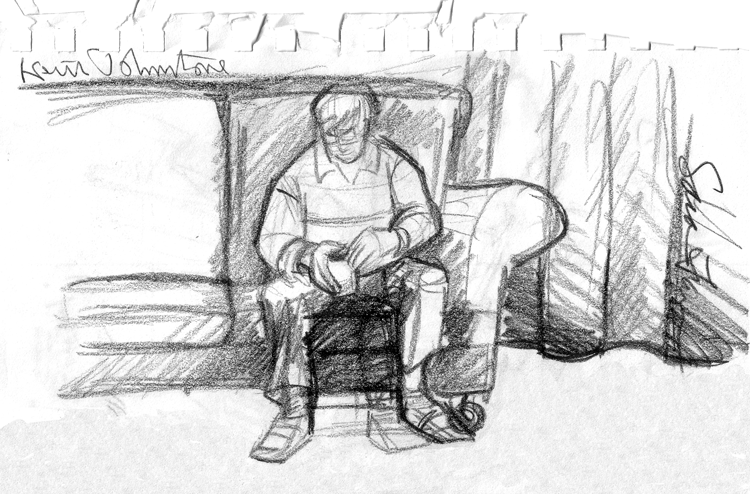

Keith Johnstone used to open his workshops sitting on the edge of the stage, looking at a paper coffee cup. Fiddling with the rim. He’d glance up, take a labored breath, and say: “I don’t know what you know.” Pause. “So, I don’t know what to teach you.” More fiddling with the cup. Then, finally: “But if you wanted to try something, we could.”
No clapping. No warm-up games. No confident instructor voice telling a room full of strangers to trust the process. Most improv classes open with energy and volume — the teacher radiating the confidence the students are supposed to borrow. Keith opened by handing his own status away before anyone had asked for it.
It wasn’t an act, or if it was, it was a precise one. When something went wrong in an exercise, and it often did, Keith didn’t correct the player. He said, “That’s my mistake. I’m not very good at explaining this exercise.” I’ve used this line hundreds of times since, in workshops with executives who are far more anxious about looking foolish than any theater student ever was. I explain an activity carefully, ask if there are questions, and watch someone get it fundamentally wrong anyway. I know exactly what to do: take the blame. Not because it’s generous, but because it’s mechanical. Status isn’t something you hold — it’s something you assign to the person across from you the moment you move. Lower yourself, and you’ve raised them, whether either of you meant to or not. Keith understood that a roomful of relaxed people will risk something interesting, and a roomful of people managing their own fear will not. So he spent his own status, deliberately, at the door.
That’s the part a New York Time piece on improv’s popularity in tech circles gets only half right. It notices status games. It misses that status is never a possession — it’s a transaction, and someone teaching from a position of “I don’t know” is not being humble. He’s rearranging the room.
The second thing the article misses is where meaning actually comes from when two people agree to make something together. Johnstone has a game called Eyes, in his book Impro — a wordless drawing exercise. Two people, one drawing. No talking, no discussing, no asking. It starts with two small circles: eyes. Then each person takes a turn adding one thing, in silence, until one of them feels the portrait is finished. The other doesn’t add anything more. Then, in the same alternating silence, they add letters, a name, a caption, whatever arrives, until someone decides that’s finished too.
Neither person could have drawn that portrait alone. Neither could have told you, beforehand, what it would become. I often ask a group afterward whether it would have felt different if I’d simply told each of them to draw a portrait individually. They always say the same thing: that would have been stressful. This was fun. Nobody was authoring anything. The thing that emerged belonged to the agreement between them, not to either of them.
That’s the part worth sitting with if you’re going to compare improv to how founders build companies. A founder’s “reality distortion field” is one person’s vision, imposed and sold. What happens in Eyes is the opposite structure entirely, meaning surfacing from two people’s willingness to add to something without controlling where it goes.
Which brings me to the actual argument, and the moment that sharpened it for me. Years ago, mid-scene, someone in the audience dropped something on the wooden floor of the theater, a loud, unplanned crack that startled the actors on stage and everyone in the room. There was a short pause. Then one actor turned to the other: “Did you hear that?” The other: “Yes. We’re not alone in this house.” The noise became the story.
No negotiation happened. There wasn’t time for one. What happened was two people, already bound by an agreement to build something together, absorbing an inconvenient, real fact into the fiction instead of pretending it hadn’t happened.
That’s the precise place where the comparison to Silicon Valley’s reality-distortion fields breaks down. A founder facing an inconvenient fact, a failed test, a missed deadline, a number that doesn’t work, isn’t rewarded for incorporating it live in front of everyone. The job, in that worldview, is to make the fact not count: reframe it, out-narrate it, keep the story moving until the room stops noticing. Improv’s version of “reality is malleable” bends to include the true and unplanned. The founder’s version exists to exclude it.
That difference is the whole thing. Improv’s collaborative reality is a contract, renewable, and revocable, by either player, at any moment, including the moment an inconvenient truth walks in from the audience. Nobody in that theater could have overruled the actors’ choice to acknowledge the noise, and nobody at a company can force a founder to acknowledge the fact he’s decided not to see. Borrowing the vocabulary, yes-and, status, collaborative reality, while discarding the one thing that makes it safe is not the same practice wearing a different outfit. It’s a different practice altogether.
But a contract that can be broken at any moment, by either party, is not a grim thing to live inside. It’s the opposite. It’s the reason two people can improvise a portrait neither could have planned, or turn a dropped object into a ghost story, and feel fun instead of exposed. Nobody’s managing anybody. Nobody’s out-narrating an inconvenient fact. You’re just free to add the next thing, badly if need be, because the other person agreed to catch it.
That’s the part worth chasing directly, not reading about secondhand.
Johnstone’s own book, Impro, is where I’d send anyone curious enough to have gotten this far, it changed how I see a room, and I’ve been in rooms with it for forty years and I’m still finding things in it I missed. But better than the book is finding a group actually working from these principles and taking a workshop. Read about a contract, or go make one with strangers for an hour. The second one is where the fun actually lives.
There’s a longer conversation about how Keith actually taught, not what he taught, but the pedagogy underneath it, which I spent a session unpacking this summer at the Global Improvisation Initiative Symposium in Portland. That’s a piece for another day.
You must be logged in to post a comment.